


- Remove the current class from the content27_link item as Webflows native current state will automatically be applied.
- To add interactions which automatically expand and collapse sections in the table of contents select the content27_h-trigger element, add an element trigger and select Mouse click (tap)
- For the 1st click select the custom animation Content 27 table of contents [Expand] and for the 2nd click select the custom animation Content 27 table of contents [Collapse].
- In the Trigger Settings, deselect all checkboxes other than Desktop and above. This disables the interaction on tablet and below to prevent bugs when scrolling.
What is sea buckthorn good for? It is a question we ask most often in autumn. Scarves and thicker jumpers come back out of the wardrobe, and we remember the small orange berries with their tart, sour taste. The days are shorter, the radiators are on, and the wind stings our cheeks. We look for something that will help us through this season in good shape.
The answer has two sides. Sea buckthorn can be eaten and drunk, and it can also be rubbed into the skin.

Orange berries full of vitamin C
Sea buckthorn owes its reputation to vitamin C. In many fruits, this vitamin is lost through heat and long storage. In sea buckthorn, it stays stable even after cooking or drying [1].
In practice, this means more freedom in the kitchen. Sea buckthorn works well in a hot infusion, a homemade syrup or a dried tea blend. Sea buckthorn juice can even replace lemon in an everyday diet [1]. It is thick and distinctly sour, so it is usually added to water or tea.
The berries also contain flavonoids and carotenoids. Together with vitamin C, they have antioxidant properties [1]. This matters especially in autumn and winter, when there is less fresh, seasonal fruit in our diet. Sea buckthorn oil, in turn, contains unsaturated fatty acids, which is why the plant also finds its way into cosmetics.
Under the researchers' lens – from tradition to hard evidence
Sea buckthorn has been studied both in the diet and on the skin. Two studies show clearly where legend ends and results begin.
Cold season – what scientists in Finland checked
The study involved 254 healthy people who ate sea buckthorn berries or a placebo [2]. The result may disappoint anyone looking for a simple fix for a runny nose: the sea buckthorn group had no fewer colds, and they did not pass any faster. Something else changed, though, something you cannot see with the naked eye. Levels of CRP fell, a marker of inflammation that doctors check in a blood test. Sea buckthorn is no shield against a cold, but the body clearly notices it.
Skin repair after burns – what doctors observed
A second-degree burn is more than redness. The skin is damaged more deeply, and blisters often appear. In a hospital in Iran, 55 such patients were treated with a sea buckthorn cream or a standard silver-based medicine. In the sea buckthorn group the wounds healed faster, which meant an earlier end to treatment for the patients [3].
The studies used preparations with a precisely chosen composition. Cosmetics draw on the same plant every day: massaged into hands and cheeks tired by the wind, they help bring back a feeling of softness and comfort to the skin.
Sea buckthorn from Gorvita – in capsules and in an ointment
On a walk, the cold wind whips the skin, and at home the warm air from the radiators dries it out. You notice it first on your hands and cheeks.
Gorvita's Sea Buckthorn Ointment combines sea buckthorn extract and oil with calendula, allantoin and panthenol. Calendula soothes redness and irritation, which is why it suits the care of sensitive skin. Allantoin and panthenol help hold water in the epidermis, leaving the skin smoother and more supple.
The ointment has a light texture. It spreads easily and absorbs quickly, so you can put your gloves on a moment later without worrying about greasy marks. It leaves a thin, protective film on the skin that helps keep it moisturised. The ointment works well:
- on hands after a walk without gloves,
- on cheeks and a nose reddened by the wind,
- on elbows and knees dried out by the radiators.

Sea buckthorn can also be taken in capsules. In the Sea Buckthorn and Acerola supplement it is paired with acerola, a natural source of vitamin C. Two capsules provide 500 mg of sea buckthorn fruit extract and 75 mg of vitamin C. That is 94% of the Nutrient Reference Value for vitamin C. Vitamin C contributes to the normal function of the immune system.

Resilience also means sleep, time outdoors and a calmer pace of life. We describe winter rituals that help with this in Winter balance.
For a chilly evening – a warming sea buckthorn drink
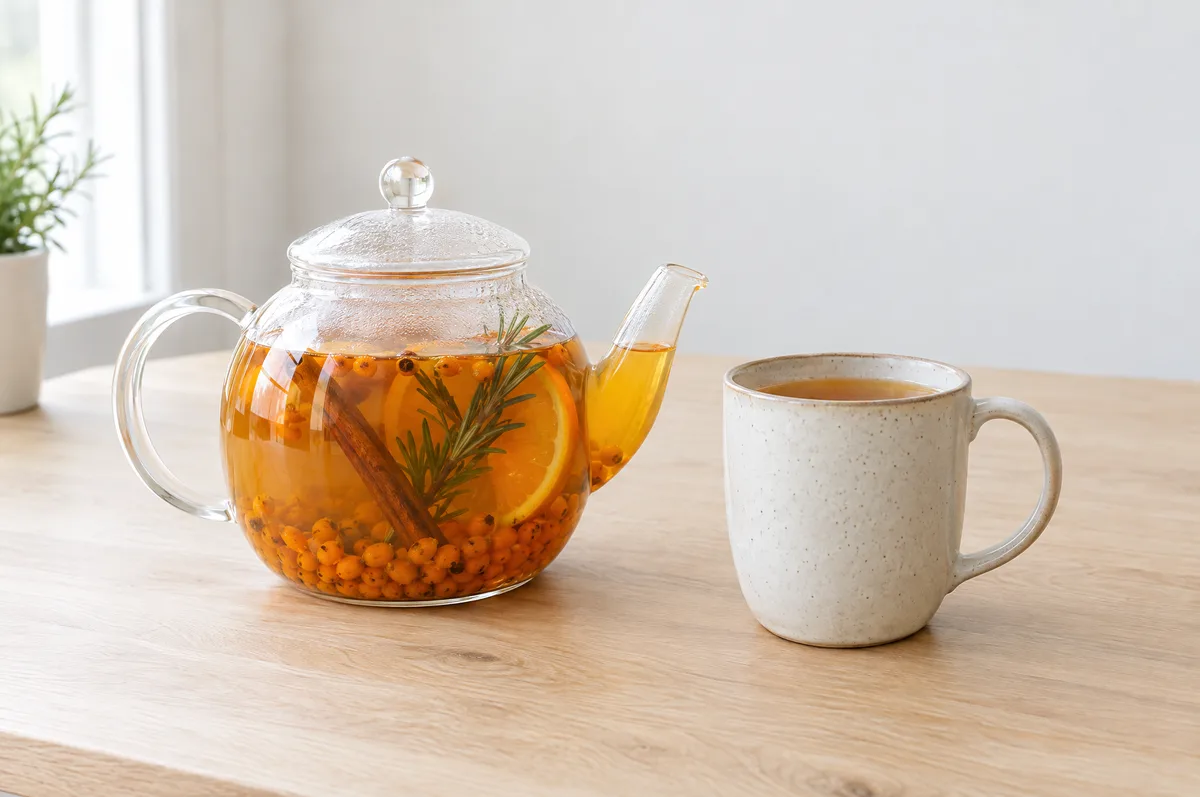
Finally, something from the kitchen. This drink combines the sourness of sea buckthorn with the resinous note of rosemary and the spicy sweetness of cinnamon. Sea buckthorn keeps its properties even after cooking. A hot mug is therefore an easy way to keep it close at hand all autumn.
Ingredients for two mugs:
- 2 heaped tablespoons of frozen sea buckthorn berries,
- a sprig of fresh rosemary,
- a cinnamon stick or 2–3 cloves,
- a slice of orange,
- a teaspoon of black tea (optional),
- 1–2 teaspoons of honey.
Crush the sea buckthorn with a spoon in a jug so the berries release their juice. If you have no frozen berries, 2–3 tablespoons of sea buckthorn juice will do. Add the rosemary, the cinnamon or cloves and the orange slice. If you like, add the tea as well. Pour boiling water over everything, cover and leave for 5–7 minutes. Take the tea out after three minutes so the drink does not turn bitter. Strain into mugs. Stir in the honey only once the drink has cooled slightly: it will keep its delicate aroma.
If an infection drags on, it is best to talk to a doctor. The same goes for a burn covering a larger area of skin. For ordinary autumn evenings, a warm mug in your hands and a moment for yourself are enough. Autumn does not have to be grey when it has the colour of sea buckthorn.
Sources
[1] Urbaniak S, Kaźmierczak-Barańska J, Karwowski BT. Sea buckthorn (Hippophaë rhamnoides L.) as a vitamin C treasury. Postępy Biochemii 2019;65(3):212–216. PubMed
[2] Larmo P, Alin J, Salminen E et al. Effects of sea buckthorn berries on infections and inflammation: a double-blind, randomized, placebo-controlled trial. European Journal of Clinical Nutrition 2008;62(9):1123–1130. PubMed
[3] Abdullahzadeh M, Shafiee S. To compare the effect of sea buckthorn and silver sulfadiazine dressing on period of wound healing in patients with second-degree burns: a randomized triple-blind clinical trial. Wound Repair and Regeneration 2021;29(5):732–740. PubMed
This article is for information only and does not replace medical advice.


